


Key takeaways
 A context layer sits between enterprise data platforms and the systems that use their data. It turns fragmented records into a connected, decision-ready view of an organization’s world.
 - Real-world context is the critical differentiator within the context layer; it shows how records fit into the wider reality surrounding a decision.
- Enterprise AI needs this context because a convincing, plausible output can still arise based on an incomplete picture. A context layer infused with real-world context gives models and agents access to clearer evidence and business meaning.
- Semantic layers, ontologies, entity resolution, knowledge graphs, and decision traces each contribute a different part of the context layer needed to support a decision. Real-world context intersects with each of these parts but also shapes the complete package ultimately presented to the agent.
Enterprise AI is entering a new phase, where models and agents are expected to support production workflows at scale rather than simply retrieve information. As organizations place greater trust in AI-driven decisions, providing consistent business context has become increasingly important.
This guide provides a comprehensive introduction to the context layer, explaining why it matters for enterprise data and AI, how it fits into the wider enterprise architecture, and the technologies that make it possible.
What is a context layer?
A context layer is an architectural layer that sits between raw enterprise data and the systems that use it, such as AI agents and analytics tools. When systems of agents operate together, they need to think in common and execute tasks in common appropriate to the organisation. This is the organisational gap that the context layer fills.
The context layer stack gives the agent structure, meaning, mappings, and even relationships, but it can’t answer the most fundamental questions around entities and identity: Who is really involved, who is connected to what and whom, and why does it matter? This is where real-world context comes into the equation.
For example, real-world context can help reveal that two records belong to the same customer or that a seemingly standalone business is part of a wider ownership network, changing how the organization assesses risk. This infuses the context layer – the situational plane that gives organizational meaning to the agent – with differentiating knowledge. It creates a dependable basis for critical decision-making at scale and supports more reliable, auditable use of AI.
A context layer infused with real-world context brings together several capabilities:
Entity resolution establishes who or what the data refers to
Semantic models and ontologies add business meaning, building on top of schema, data models, and metadata
Knowledge graphs reveal the connections around each (resolved) entity
Provenance helps show where the supporting information came from
Decision traces can extend this foundation by preserving the context behind previous outcomes
Together, these capabilities create a bridge between data language and business language, while infusing the agent with the truth it requires to fulfill its task.
What does context mean in data and AI?
The word “context” has become heavily overloaded with meaning as Generative AI and then agents have evolved alongside traditional data science and machine learning.
In data and AI, “context” can mean anything from a model prompt to the detail held in a customer record to semantic similarity. One useful way to understand these different meanings is to distinguish between five practical forms of context, then focus on the kind that makes enterprise data decision-ready.
Prompt context: the task-specific instructions and examples given to a model. This helps guide an individual response, but it only gives the model a narrow view of the problem.
Window context: the amount of information a model can process within a single interaction or workflow. This affects how much material the model can reference, but it doesn’t guarantee the material is complete or relevant.
Semantic context: vector embeddings, vector search, and vector databases help systems understand what an item represents through semantic similarity, how it relates to other data, and how relevant it is to a user's query.
Record context: a 360-degree view of a customer; everything you know about them stored in one place. This can support a clearer view of one entity, but there’s a chance it misses the wider relationships around it.
Real-world context: an understanding of who someone really is once their records and relationships are connected across the enterprise, and what these connections imply for the decision at hand.
The first three forms in this framework can only take AI so far while the fourth allows agents one form of limited context. Real-world context is what allows systems to interpret the wider situation behind a decision and, when it’s set within a context layer, enables agent-supported decision-making at scale.
At its core, real-world context gives a system the information it needs to answer three questions:
Who is involved? Real-world context identifies the key entities behind the decision, from customers and suppliers to accounts, assets, and locations.
How are they connected? It shows the relationships that change how this entity should be understood, from ownership links to patterns of activity.
Why does it matter? It connects those relationships to the decision itself, including the relevant history, policy position, and evidence.
Automation determines how quickly and widely AI can act. Context determines whether those actions reflect the right interpretation of the situation. Without it, AI can scale a flawed decision just as efficiently as a well-founded one.
Why enterprise AI needs a context layer
Context has moved to the center of the enterprise AI conversation because AI is starting to play a more active role in how organizations work. AI agents can now support complex enterprise processes from end to end, rather than being limited to standalone tools or narrow use cases. As adoption grows, organizations need to ensure these systems can interpret the wider context behind each action.
This places new demands on enterprise data. Access to more information can help, but the system must also be able to connect that information and interpret its relevance to the situation at hand. Gartner’s recent focus on semantics and metadata as foundations for AI agents reflects this shift, with the analyst firm linking stronger semantic context to improvements in accuracy and cost efficiency. The role of knowledge graphs to connect and aid understanding of organizational fact is also integral. But it's important to recognize that knowledge graphs, as well as metadata and semantic context, only deliver value when identities are true and resolved.
Consider the kinds of questions AI is increasingly expected to support:
Which customers are most exposed to disruption in a critical supply chain?
Has a vulnerable customer already been granted an exception that should influence the next decision?
Does a business sit within a wider ownership network that changes its risk profile?
The answers to these questions are likely to depend on connections spread across several systems. They may also need to reflect policy, recent events, or the reasoning behind earlier decisions.
Without this wider context, enterprise AI drawing on a vanilla context layer can:
treat records about the same entity as unrelated;
apply a policy without recognizing a relevant exception;
overlook a relationship that changes the risk;
produce a recommendation that is difficult to explain or defend.
Despite this, the output may still sound convincing and plausible, making the gap particularly difficult to spot. Left unchecked, those errors can cascade throughout the agentic infrastructure.
What is the difference between a context layer and a semantic layer?
A semantic layer forms part of the context layer but serves a more specific purpose: connecting meaning to enterprise data and infrastructure. It helps organizations consistently query their data based on agreed definitions and an established ontology, while the context layer provides the broader situational context needed by the agent.
For example, a semantic layer can ensure that “active customer” has the same definition across reports and systems. A context layer goes further by identifying which customer the record belongs to and enriching that information with real-world context that could change the outcome, such as a previous exception or a relevant relationship.
| Semantic layer | Context layer |
Primary role | Translates data into consistent business terms | Connects data and meaning to the agentic – or operational – action |
Core question | What does this data mean? | What context is needed for the agent to understand and act on it? |
Typical scope | Metrics, definitions, and business concepts | Names, relationships, evidence, and history compiled in a consumable form |
Used by | AI applications, analytics, and business intelligence | AI agents, analytics, and operational applications |
A semantic layer therefore contributes to a context layer, but it doesn’t aggregate and deliver the full context on its own for the agent to act on its given task.
How do ontology, entity resolution, and graphs fit into a context layer?
Capability | What it contributes | Question it answers | Why it matters |
Ontology | A formal model of the concepts, relationships, and rules within a domain | What matters in this domain, and how does it relate? | Applies the rules of the organization to context |
Entity resolution | A way to determine whether records from separate sources refer to the same real-world entity | Are these records about the same person, organization, account, or asset? | Informs the truth delivered by the context layer |
Knowledge graph | A structured view of entities and the relationships between them | What is connected? | Needs to be predicated on real, proven identities |
Decision trace | Agentic records of the circumstances and reasoning behind an outcome | Why did this happen? | Enables agentic improvement of decision processes |
Entity resolution provides an essential starting point by identifying which records refer to the same real-world person or organization. It brings fragmented records together while keeping genuinely separate entities distinct.
A knowledge graph can then reveal how resolved entities relate to the wider world. For example, it might show that a business shares directors with another company or is linked to a high-risk entity through several connections.
Decision traces preserve what happened around a particular outcome, perhaps as part of a ‘context graph,’ including how a rule was interpreted or why an exception was approved.

“Context graph” is a developing term further to Foundation Capital’s article on Context Graphs. It can feel circular because all graphs contain some form of context and an event log, statechart, or time-based record can serve the same purpose.
The context layer brings these capabilities together and makes the resulting context available wherever it’s needed. This gives decision-makers and AI systems a shared view of what the data represents and why it matters in the situation at hand.
From ambiguous records to a decision-ready view in an AI-native environment
The easiest way to see these capabilities working together is to follow a decision from its initial data picture to a fully contextualized view. Take a simple example:
A database appears to show one person named John Smith who lives in Boston and owns two expensive cars. Entity resolution reveals that there are actually two people with the same name: one living in Boston, Massachusetts, and another in Boston, Lincolnshire. Each owns one car.
Once the records have been correctly resolved, the context layer can bring in the wider information surrounding each person and purchase. This reveals that one vehicle may have been bought using funds linked to criminal activity, while the other may have been funded through legitimate investments.
When the records are separated and placed in context, the two cases point to very different outcomes. One person may warrant investigation for possible money laundering; the other could be a credible investment prospect.
For a fuller exploration of this scenario, read our article on why context can be automated even when understanding cannot.
How do you add real-world context to fragmented enterprise data?
So, how does an organization actually go about building a context layer? A practical starting point is to focus on a decision where better context could materially improve the outcome, such as identifying financial crime risk or assessing a vulnerable customer’s circumstances.
Teams can then work backward to establish what information the workflow needs.

Connect the relevant data
Bring together the sources needed for the decision in scope. These could come from internal systems or trusted third parties.

Resolve the entities
Establish which records refer to the same real-world person or organization. This creates a reliable identity foundation before wider relationships are mapped.

Define business meaning
Agree how the concepts and rules within the workflow should be interpreted. Semantic models and ontologies can then connect this meaning to the underlying data.

Map real-world relationship
Use knowledge graphs to show how resolved entities connect across the wider data estate. These relationships can reveal information that changes how the decision should be approached.

Add decision context
Apply contextual analytics based on the resolved entities and graph relationships. Also preserve the evidence behind previous outcomes so later decisions can account for relevant history. This could include an approved exception or the reasoning behind an earlier action.

Make the context available
Deliver the resulting view to the systems, AI agents, and people using the outcomes. Machines need structured context, while human users must be able to inspect the information behind an outcome.

Keep it current
Refresh the context as the real-world situation changes. Each new decision can also add useful knowledge to the foundation over time.
Building a context layer also means making the organization’s own understanding explicit. The supporting infrastructure can organize data into a connected view, but only the business can determine how that view should influence a decision. This is why the work needs to remain grounded in workflows relevant to the organization rather than a generic model of context.
What are the challenges of building a context layer?
As with any initiative that spans data, AI, and business operations, building a context layer creates both technical and organizational challenges, particularly with AI evolving so quickly.
Defining what context is relevant: Different decisions require different views of the same entity. A fraud investigation may depend on transaction relationships, while a customer-service workflow may need recent interactions and approved exceptions. Organizations need to provide enough context to support the task without treating every available data point as equally important.
Balancing reuse with decision-specific needs: A shared contextual foundation can support several workflows, but each one still needs its own rules and evidence. The architecture must allow teams to reuse resolved entities and relationships without forcing every process to work from an identical view.
Establishing ownership of meaning: Business concepts, policies, and exceptions often span several teams. Organizations need clear ownership over how these are defined and updated so the context layer reflects how decisions are actually made.
Keeping context current and traceable: A context layer needs to reflect the situation as it changes. It should also preserve enough history to show which information supported an earlier decision.
Governing access and action: A context layer can expose sensitive relationships and influence consequential decisions. Organizations therefore need clear controls over how the context is accessed and acted on, with human review built in where necessary.
How does a context layer with real-world context support agentic AI?
A context layer supports agentic AI by grounding each action in a connected view of the situation and the evidence behind it. This becomes increasingly important as agents move through multi-step workflows and influence decisions with genuine consequences.
Relevant policy and decision history can help an agent recognize when a precedent applies and when the current case requires a different response. People can also review how the outcome was reached because the supporting evidence remains visible.
Human expertise remains central to this model. A context layer allows people to focus more closely on the cases that require judgment by reducing the time spent piecing together fragmented information. This creates a more legible form of automation that can operate at scale while standing up to scrutiny.
Quantexa’s perspective on the context layer
At Quantexa, we see the next phase of enterprise AI as a shift from smarter models to more legible systems. Models can only act reliably when the environment around them provides a clear view of the entities involved and the evidence shaping the decision. With AI proliferating, the importance of having that clear view increases, because otherwise what is plausible but either false or imperfect perpetuates by orders of magnitude.
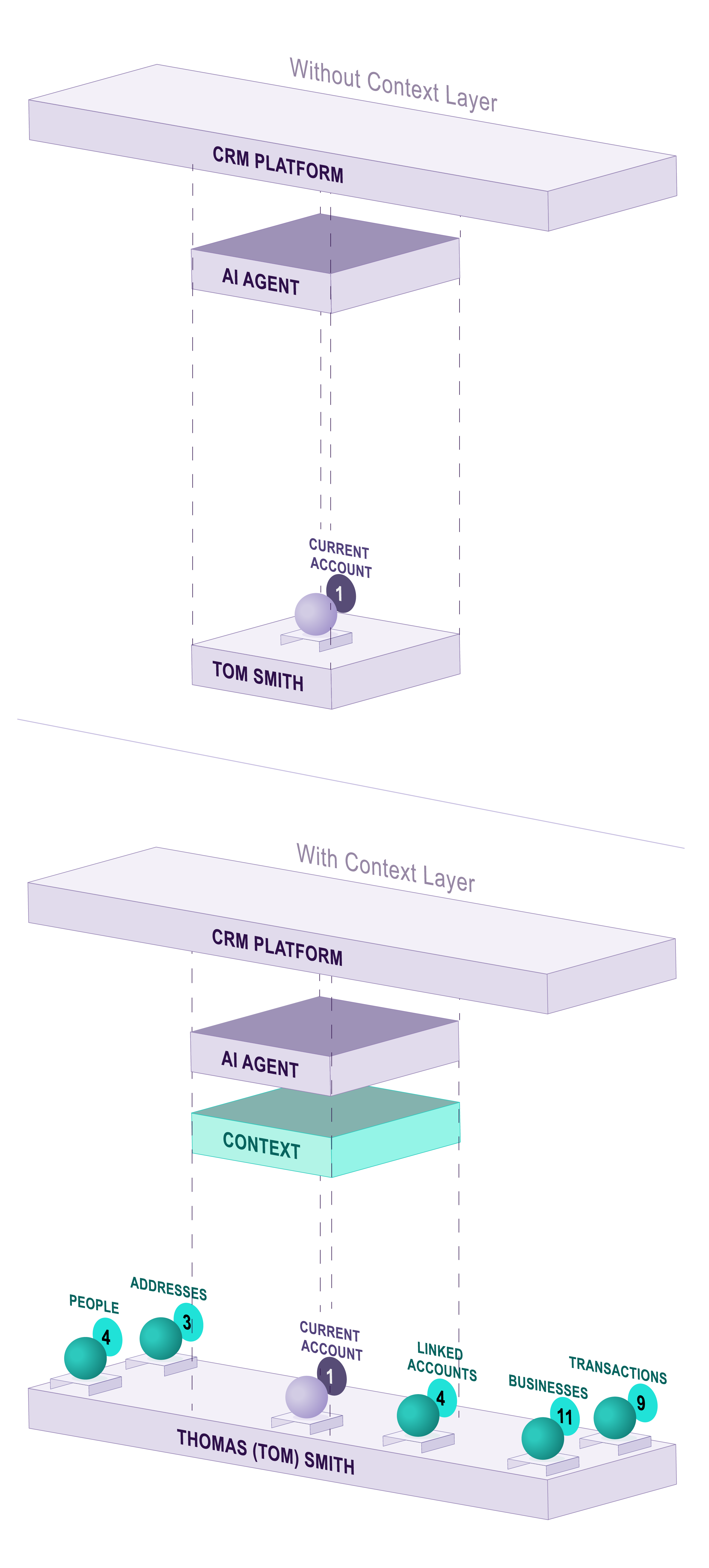
This starts with entity resolution. One unilluminating Tom Smith record in a CRM delivers limited intelligence for an agent to act on, but four unified records showing significant value through multiple accounts and 37 connections with full event history offer much more scope for the context layer. Once fragmented records are connected to the right real-world people and organizations, knowledge graphs, for example, can reveal the wider relationships that change the picture. Provenance and decision history then make the path to an outcome visible.
Our Contextual Fabric

Your FAQs about context layers answered
Why does context need its own layer?
Context needs its own layer so it can be developed and maintained as a shared enterprise capability. Without this shared foundation, each application has to reconstruct meaning from fragmented data, often using different rules or assumptions.
A context layer makes the capabilities needed to interpret that data available across the organization. This gives downstream systems a more consistent view of what the data represents and why it matters to the decision at hand.
How does context improve decision-making in fraud detection or risk management?
Context improves fraud and risk decisions by showing how an apparently isolated record fits into the wider picture. It can reveal relationships that change how a customer, transaction, or business should be assessed, helping investigators distinguish genuine risk from misleading signals. This is real-world context in action.
This wider contextual view also makes it easier to understand why an alert matters and whether further action is justified. Investigators can see the evidence behind the decision rather than relying on a single data point or rule.
Context also supports explainability by preserving the information that shaped the outcome. This makes it easier to justify why a Suspicious Activity Report (SAR) was raised or why a particular risk action was taken.
Is a context layer the same as a semantic layer?
No. A semantic layer forms part of the context. However, the semantic layer maps technical data to shared business terms, helping teams use consistent definitions for concepts such as revenue, active customer, or policyholder for example.
A context layer uses this meaning as part of a broader view. It can also incorporate real-world context, unifying records that refer to the same real-world entity, reveal relevant relationships, preserve provenance, and include decision history. The semantic layer can therefore contribute to a context layer, but it doesn’t provide the full decision context on its own.
Is a context graph the same as a knowledge graph?
No. A knowledge graph represents facts about entities and the relationships between them. By showing how entities connect, it can reveal relationships that change how an organization should be understood.
A context graph is an emerging term for the connected organizational knowledge that develops as the circumstances behind decisions are preserved over time. Individual decision traces can record why a rule was applied or how an earlier case was resolved.
Useful links
We’ve discussed context in detail in this guide. However, there could be more you want to know about the impact it can have on your organization. Browse the following articles for further reading.